The Lands of the Inner Sea
The world drowned once. Ea, the creator in the oldest human stories, sent the flood, and what came after was built on the ruins. The past isn't finished here. Look closely and the flood is everywhere: drowned roads, dwarven ruins, older shrines under newer ones.
You play the people of Aliador
Sellswords, scholars, wardens, duellists. Some of you carry a god's mark and some don't. Trouble finds you where old power is still at work: a marked family's secrets, a ruin older than the flood, a debt owed to the wrong people on the Tunas docks.
The tone is grounded and dangerous. Magic is real and it costs the people who use it. Politics and family matter as much as monsters. The heroes are rarely clean, and nobody in this world is wholly good or wholly evil.
Nobody earns a Bloodmark and nobody chooses one. What a person does with what they were born holding is the only part that is theirs.
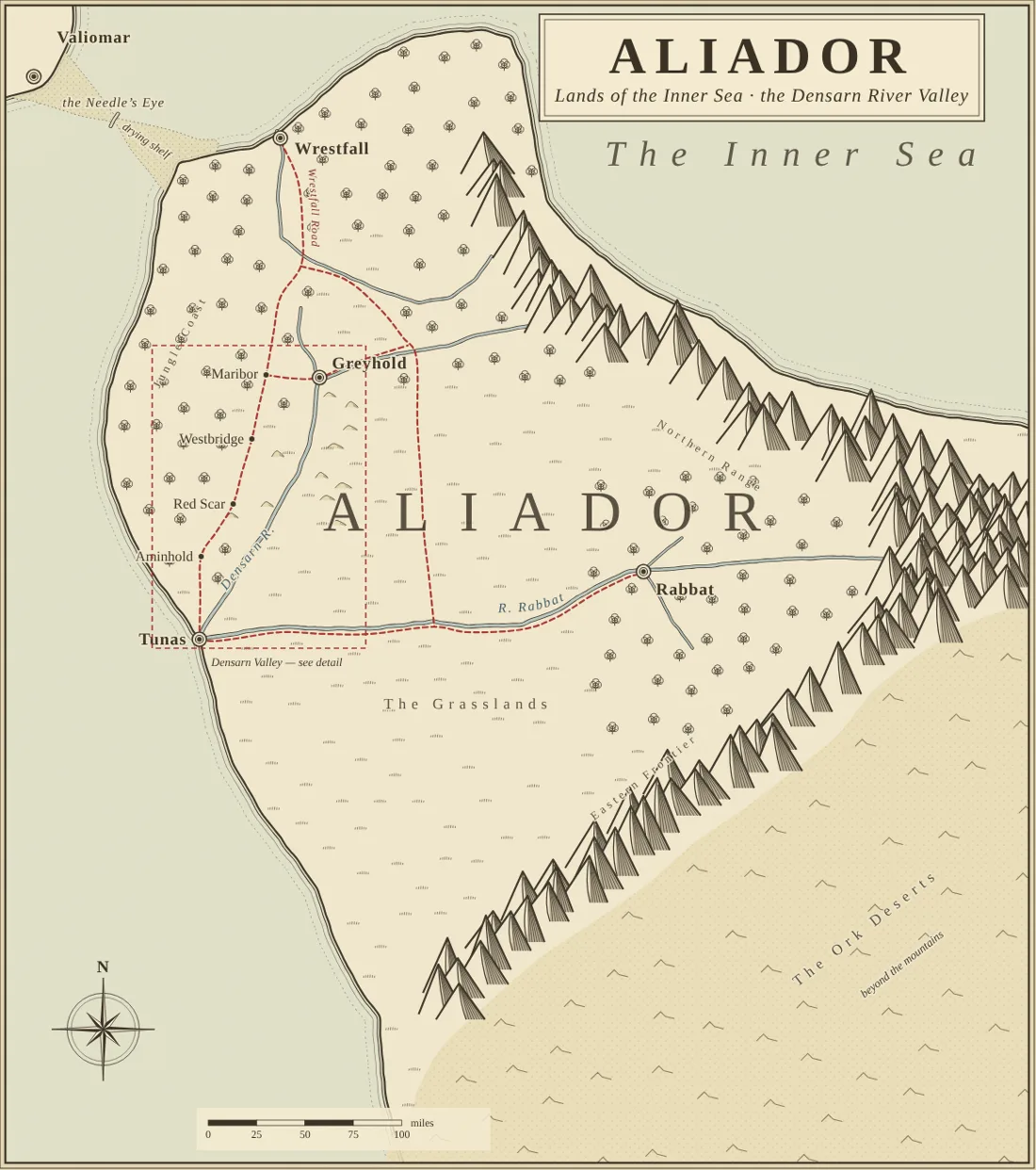
Good land, well worth fighting over
Aliador has good water, long sunshine, generous harvests and fine grazing. Mountains along its eastern side catch the rain, which is why the land beyond them is desert.
Three great rivers rise in those mountains: the Densarn and the Wrestfall in the Northern Range, and the Rabbat where the two ranges meet. Tunas is the great port on the Open Ocean. Greyhold is the walled city at the river fork. Wrestfall stands where its river meets the Inner Sea.
The Needle's Eye. A shallow shelf runs out from each shore across the strait, a metre under water at high tide and dry at low, split down the middle by a deep trench a few miles long. The shelf dams the Inner Sea and the trench is its spillway. Ships time their passage for high water. Sailors dread the Eye as the tide turns, and only the brave run against the spill.
Gods hold domains, not moral sides
Death is not evil, and Life is not good. A domain says what a god governs, never whether it's right.
| God | Domain | Nature | What their marks do |
|---|---|---|---|
| Zeroth | Control | proactive | Control, Life and Future need a will to hold them, so these marks act by choice. |
| Geia | Life | proactive | |
| Arakni | Future | proactive | |
| Eolis | Freedom | reactive | Freedom, Death and Past persist on their own, so these marks can only restore what was taken. You can't grant freedom to someone who already has it. |
| Xanarii | Death | reactive | |
| Garlett | Past | reactive |
A god's power, inherited at birth
The gods' children, the saints, left bloodlines behind. A Bloodmark is part of what a character is. It's chosen at character creation, it's independent of Class Principle, and it runs on Stamina like everything else.
Sensitive
Morthea · Zeroth's lineReads the past off a room, an object or a person like a smell. Sometimes the past reads you back.
Fatespinner
Althea · Zeroth and ArakniDeclares the outcome of a roll, and it stands as fixed reality until she dies.
Jumper
Ankar · Arakni's lineSlips a few seconds back and takes the failed shot again. No Jumper can undo a Fatespinner's word.
Vital
Talkiria · Geia's lineUntouched by poison and disease, and once a rest can bring their own body back from the edge.
Breaker
Falera · Eolis's lineBreaks the hold of a compulsion on an ally. Freedom is the default, so this mark only ever restores it.
Requiem
Raylis · Xanarii and GarlettAsks the dead what they knew. They answer, if they still have a tongue, and they don't have to want to help.
Eighteen marks, one fork in the road
A Bloodmark is optional. A character who goes without one can train in Elemental Magic instead, bending fire, earth, air and water from the world around them. The two never mix: the blood interferes with channelling the elements. You choose your lane at character creation and live in it.
Who you are is not what you carry
No mark is good or evil, and none is evidence of either. Two people with the same mark will look nothing alike. The rules never settle a moral question. That belongs to the table.
Humans are the many. The others are the edge.
Most of the people the party meets will be human. Elves hold the forests of the cold north. Orks hold the deserts beyond the eastern mountains, and their raiders have crossed before. Both are fiercely territorial, so meeting one should be an event.
Dwarves were the people of the deep. They survived the flood underground, and Zeroth's chosen finished them afterwards. What remains of them is mostly ruins.
Questions for your table
- Does your character carry a Bloodmark? Who in your family knows, and who would pay to know?
- Which of the six gods does your family honour, and which do they avoid naming?
- What ruin, older than the flood, did you grow up near? What did the adults say about it?
- Who on the Tunas docks would recognise you, and is that good or bad?
Somewhere to start
The Salt Quarter Docks
Coiled rope, drying nets and the shouting press of the morning fish market. Ships from across the Inner Sea unload here, and so does everything that travels with them: news, rumour and the occasional smuggled cargo.
The Ferry Shrine at Longreach
A weathered shrine to Garlett beside the only reliable ford for a day in either direction, hung with ribbons and coins from generations of travellers. The water is calmer to look at than it is to cross.
The Hollow Barrow of Nine Roots
A burial mound older than any nation on the Inner Sea, ringed by nine dead trees that never rotted. The farmers leave it alone out of habit, or they did, until something inside woke up.